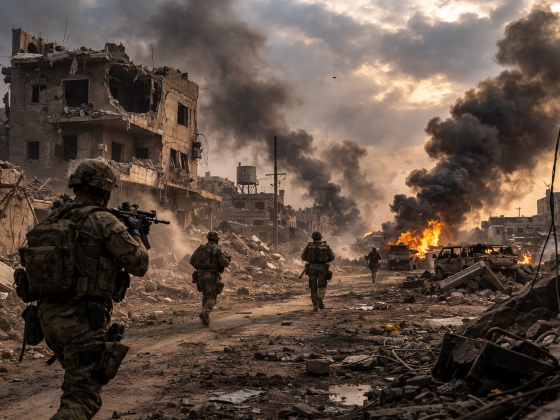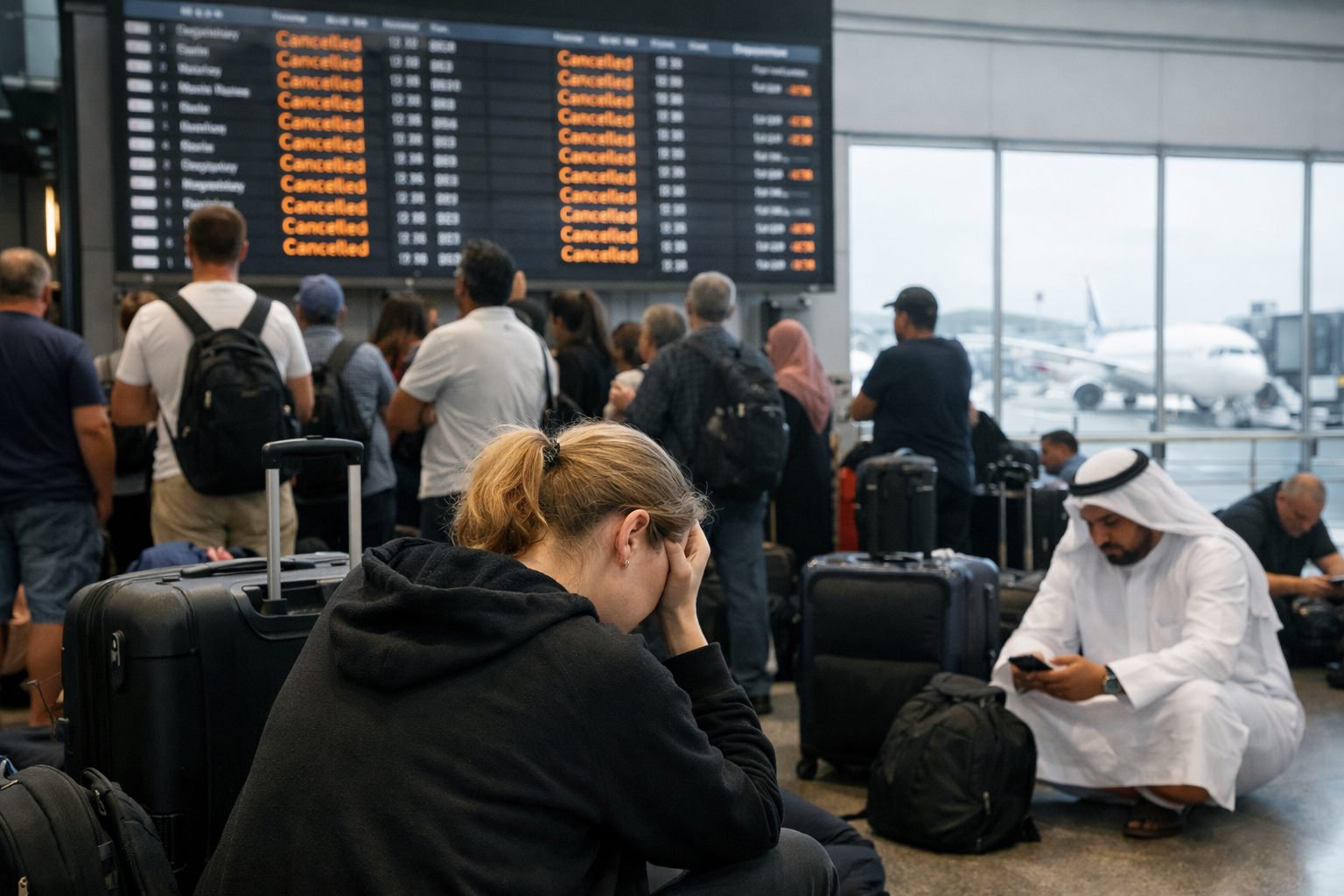
The Iran-Israel conflict has quickly spilled into the global travel industry, triggering flight cancellations, airspace closures, and major disruption across the Middle East.
Missile and drone strikes across Gulf countries have forced airlines to suspend operations and reroute aircraft, leaving thousands of travellers stranded and forcing airlines to rapidly adjust flight paths.
One of the clearest signs of the disruption came when missile debris fell over Dubai’s Palm Jumeirah, a luxury tourism district known for its hotels and restaurants.
The debris sparked a fire that injured four people.
Since Iran launched its retaliatory strikes, more than 27,000 flights have been cancelled worldwide, according to aviation analytics firm Cirium.
Airlines are attempting to navigate restricted airspace and rising security risks across several regional corridors.
Gulf airspace shutdown
The immediate shock to aviation has been the closure or restriction of airspace across parts of the Middle East.
Following US-Israeli attacks on Iran and Tehran’s retaliation, countries across the region imposed limits on commercial flights and tightened aviation security.
These restrictions disrupted major aviation corridors linking Asia, Europe, and Africa.
Key transit hubs such as Dubai, Abu Dhabi, and Doha saw cancellations and operational delays as airlines adjusted schedules.
Dubai International Airport alone handled a record 95.2 million passengers in 2025, making it the busiest hub for international travel.
When operations slowed there, the ripple effects quickly spread across global airline networks.
Airlines also faced operational challenges as aircraft and crews ended up in the wrong locations, making it difficult to quickly restore normal flight schedules and reposition fleets across continents.
Travellers stranded across Gulf
The aviation disruption has left many travellers stranded across the region.
Government-organised repatriation flights have been arranged to help people return home, but delays continue as airlines work through the backlog.
Reports indicate that hundreds of thousands of travellers were affected as airlines cancelled flights connecting the Middle East with Europe, Asia, and North America.
Some passengers have turned to expensive alternatives, including charter flights from Dubai to Europe costing more than $200,000.
Cruise operator MSC Cruises also changed its plans after the conflict disrupted operations.
The company cancelled its remaining March sailings from Dubai.
It also arranged five charter flights to repatriate passengers from its MSC Euribia ship, which remained docked in the city after the conflict escalated.
Tourism hubs under pressure
The disruption is particularly significant for Gulf economies that rely heavily on tourism and aviation.
Tourism accounted for about 12% of the United Arab Emirates’ economy in 2023, highlighting how closely the sector is tied to the region’s economic activity.
Airlines, including Emirates, Etihad Airways, and FlyDubai, have begun restoring limited operations through a designated safe air corridor, allowing up to 48 flights per hour while authorities monitor the security situation.
Even as flights slowly resume, airlines and tourism authorities face the challenge of reassuring travellers that the region remains safe for international travel.
They must also convince passengers that aviation networks can stabilise after the sudden disruption.
According to experts, restoring passenger confidence will be critical for the sector’s recovery.
The post How Iran Israel conflict is shaking Middle East airlines, global tourism appeared first on Invezz